OR does your toilet make noises?
We have been getting more of these calls lately.
Maybe it is because it is winter and we are spending more time inside our houses (with the windows closed).
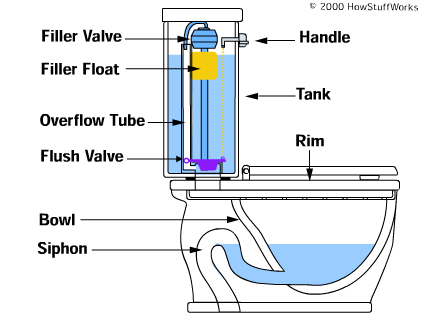
These noises could very well be caused by your toilet flapper (flush valve) allowing water to escape from your toilet tank. This in turn lowers the level in the tank which then activates that "fill valve" which is replacing the water that has leaked into your toilet bowl (and ultimately, down the drain). It will continue to do this until the flapper (and possibly fill valve) is replaced.
See images of "toilet tank flush valves"
If you need us to have a look at this (and possibly fix it, if indeed this is the cause), please give us a call at 780-266-3939.
Please read our SPECIAL OFFER before calling.
Thank you,
Jay Bortnik
AKA "Journeyman Jay"
North Edmonton, Alberta
780-266-3939
Showing posts with label toilet. Show all posts
Showing posts with label toilet. Show all posts
Saturday, February 7, 2015

Saturday, November 1, 2014
"Just" a New Bathroom - Finished
Before we start:
A big THANK YOU to our clients: Troy & Cassandra.
We really appreciate being welcomed into your home for the week or so (rough-in and, later the finishing) this took to complete.
Photos of the NEW Bathroom project we just finished.

The fixtures in this new bathroom need venting (the pipe going into the ceiling) to operate properly.
 This is the flange that connects the toilet to the piping below. It also holds the toilet to the floor.
In this case, the toilet flange is a little further from the wall to accommodate the "structural" floor joist that runs under the toilet. Typically the toilet flange is about 12.5" to 13" off the back wall.
 Water line for the toilet.
Wow. That's it, right? What about the hidden plumbing? Where are we going to get the water? Where is the waste going?
 Water line tubing and "soil" (term used when poop goes in it) pipe connected to WC (water closet) or toilet flange above.
 Waste pipe from LAV (bathroom sink) on left side which is connected to the bigger toilet pipe.
The toilet actually vents through the LAV pipe.
 We have to connect this new bathroom to the existing piping. In this case we were blessed with a 3" pipe coming from the clothes washer. But, this meant that we now had to vent a previously unvented fixture (clothes washer stand pipe). Back in the day, they did this different than we do today. Suffice to say we also re-piped the laundry so that our connection would conform to plumbing code.
 Lots of fun here. Back in the dark ages (1950s, 60s, even 70s), plumbers used a lot of cast iron for drainage (and connected it with LEAD - dangerous). Needless to say we had to make a few cuts into the cast iron to make our connection. Well it wasn't that straightforward. Here is what we found where we were going to connect the new bathroom piping. This pipe was only draining a clothes washer (for about 55 years). So we cut out the whole horizontal pipe up to where it went vertical and replaced it with plastic (abs). These cuts require special blades or special cutters (depending on preference or situation).
 Here is all the additional pipe we replaced (piled outside).
 This is what the attic looks like. There's plumbing in the attic too?? Yes there is. Remember the first picture with the vent pipe running up the wall. It has to eventually connect to a pipe that leads outside.
 More venting we installed. One pipe is from the laundry and the other is from the NEW bathroom.
We also had to cut cast iron to connect the NEW venting to the existing venting.
 Pipe must grade properly and must be properly supported (see metal strap with 2x4 board) holding pipe's grade (keeping it from sagging and filling with water - bad thing for a "dry vent")
 Here is our "green sticker" from the City of Edmonton Inspector.
He checked our piping and gave it his approval.
 Picture of the "rough-in" for the sink.


For a professional consultation (and possible estimate) give us a call at 780-266-3939.
A big THANK YOU to our clients: Troy & Cassandra.
We really appreciate being welcomed into your home for the week or so (rough-in and, later the finishing) this took to complete.
Photos of the NEW Bathroom project we just finished.
The fixtures in this new bathroom need venting (the pipe going into the ceiling) to operate properly.
In this case, the toilet flange is a little further from the wall to accommodate the "structural" floor joist that runs under the toilet. Typically the toilet flange is about 12.5" to 13" off the back wall.
Wow. That's it, right? What about the hidden plumbing? Where are we going to get the water? Where is the waste going?
The toilet actually vents through the LAV pipe.
We also had to cut cast iron to connect the NEW venting to the existing venting.
He checked our piping and gave it his approval.
A roughed-in bathroom.
(It wouldn't look like much if you didn't see all that was done)
Installing shut-off valves for the water lines for the LAV.
Braided supply tubes connecting the faucet to the water lines.
The faucet.
Installing tank to toilet bowl.
Cut those T-bolts.
The mark of a neat plumber.
The NEW bathroom.
To keep it simple we didn't show pictures of:
1. Upsizing water lines (from the water meter to the hot water tank to the other branch offs) to
accommodate new bathroom and meet plumbing code requirements for water flow..
(While doing this, we had to also change the "very old" main shut-off as it started to leak after
being turned on and off)
2. Re-piping the laundry.
So, as we mentioned in our previous BLOG posts - There are many other variables when adding a new bathroom such as: water line sizing, venting, and drainage capacity.
This also doesn't even scratch the surface on fire safety, materials, confined spaces, dangerous substances (that might be encased in the building materials of your house).
As you can see, these bathrooms must be well thought out.
These consultations and estimates differ from our normal consultations in that they involve lots of time and effort to solve plumbing challenges before anything is decided. Therefore we charge a reasonable fee for this service.
Thank you,
Jay Bortnik
Journeyman Jay Plumbing
780-266-3939
Wednesday, September 24, 2014
Your House Plumbing: Main Shut-off Valve
Hi there!
Journeyman Jay here again to talk to you about your main shut-off valve and why you should probably replace it if it occasionally drips at the stem.
Listen to Journeyman Jay (my alter ego) as he describes
what happened during a recent "new bathroom addition."
Thank you,
Jay Bortnik - a.k.a. Journeyman Jay
Journeyman Jay Plumbing
See our special offer for Norh Edmontonians who live in and own their own "single detached house"
Journeyman Jay here again to talk to you about your main shut-off valve and why you should probably replace it if it occasionally drips at the stem.
Listen to Journeyman Jay (my alter ego) as he describes
what happened during a recent "new bathroom addition."
Thank you,
Jay Bortnik - a.k.a. Journeyman Jay
Journeyman Jay Plumbing
See our special offer for Norh Edmontonians who live in and own their own "single detached house"
Thursday, July 31, 2014
Toilet Surprise
Hi there,
Sometimes there is more than meets the eye when looking at a toilet.
Last Friday, all our warnings to clients about "possible broken toilet flanges" (the things to which we seal and bolt our toilets) came true.
We lifted the old toilet to replace it with a new one that our client had purchased.
And here is what we found......
 As you can see (in the photo), we have taken the liberty of taking it apart, cleaning it up, cutting the pipe below and setting it beside the toilet hole.
The picture might have looked a lot more disgusting if we did not clean up the old wax seal (which is kind of brownish yellow in colour and gooey looking)
In this case, the toilet flange was not screwed down. It was only held in place by the tile itself and the lead bend / stub that actually folds over the flange. If you look at the left side of the photo, you will see a half flange and a missing chunk of metal. That is where the bolt would go to keep the toilet attached to the floor and the toilet drain pipe.
The next picture is that of the new toilet flange that is on its way to being installed. All we have to do is knock out the middle and screw it down (and attach it to the old copper drainage pipe in the basement).
--- and leak test it, of course (very important).

See the slots on the right and left of the flange. These are where the T-bolts for your toilet are suppose to be installed.
Needless to say, a basic toilet replacement turned into something more. There was no way for our client nor ourselves to know this before the job started. That is why we will warn you (at the time of our free estimate) that the price of a toilet replacement could increase (more time, tools, and parts are required), if we find something like this.
Anyways, that's enough about plumbing for today.
Thanks for reading,
Jay Bortnik
Journeyman Jay Plumbing
780-266-3939
Sometimes there is more than meets the eye when looking at a toilet.
Last Friday, all our warnings to clients about "possible broken toilet flanges" (the things to which we seal and bolt our toilets) came true.
We lifted the old toilet to replace it with a new one that our client had purchased.
And here is what we found......
The picture might have looked a lot more disgusting if we did not clean up the old wax seal (which is kind of brownish yellow in colour and gooey looking)
In this case, the toilet flange was not screwed down. It was only held in place by the tile itself and the lead bend / stub that actually folds over the flange. If you look at the left side of the photo, you will see a half flange and a missing chunk of metal. That is where the bolt would go to keep the toilet attached to the floor and the toilet drain pipe.
The next picture is that of the new toilet flange that is on its way to being installed. All we have to do is knock out the middle and screw it down (and attach it to the old copper drainage pipe in the basement).
--- and leak test it, of course (very important).
See the slots on the right and left of the flange. These are where the T-bolts for your toilet are suppose to be installed.
Needless to say, a basic toilet replacement turned into something more. There was no way for our client nor ourselves to know this before the job started. That is why we will warn you (at the time of our free estimate) that the price of a toilet replacement could increase (more time, tools, and parts are required), if we find something like this.
Anyways, that's enough about plumbing for today.
Thanks for reading,
Jay Bortnik
Journeyman Jay Plumbing
780-266-3939
Wednesday, July 23, 2014
Toilets - Knowing this could save you money
Hi there.
We just saw something you should not be doing with your toilet.


Just in case you can't see the words in the picture, they say:
"CAUTION
Use of in-tank cleaning products voids warranty, as they can destroy parts and cause water leaks that may lead to property damage."
This warning is clearly marked by the manufacturer in this case.
This is not an idle warning. The flapper is usually the first thing affected. The flapper will lose its seal and will cost you money in lost water. The fill valve is activated when the water level goes down in the tank. Even more frightening is how this affects the rubber washers around the bolts and the fill valve. If these were to leak while you were away, then the fill valve would constantly be on because the tank would be leaking. This could cause massive water damage.
Please do not put any chemical cleaner in your toilet tank. And always follow the manufacturer's instructions.
....Unless of course, you really want to needlessly pay for more plumbing in your house...
We didn't think so.
Thank you for reading,
Jay Bortnik
Journeyman Jay Plumbing
780-266-3939
We just saw something you should not be doing with your toilet.
Just in case you can't see the words in the picture, they say:
"CAUTION
Use of in-tank cleaning products voids warranty, as they can destroy parts and cause water leaks that may lead to property damage."
This warning is clearly marked by the manufacturer in this case.
This is not an idle warning. The flapper is usually the first thing affected. The flapper will lose its seal and will cost you money in lost water. The fill valve is activated when the water level goes down in the tank. Even more frightening is how this affects the rubber washers around the bolts and the fill valve. If these were to leak while you were away, then the fill valve would constantly be on because the tank would be leaking. This could cause massive water damage.
Please do not put any chemical cleaner in your toilet tank. And always follow the manufacturer's instructions.
....Unless of course, you really want to needlessly pay for more plumbing in your house...
We didn't think so.
Thank you for reading,
Jay Bortnik
Journeyman Jay Plumbing
780-266-3939
Monday, June 2, 2014
Journeyman Jay Plumbing PHOTOS
We have just added a separate page for select photos (when my photographer/wife is out on call with me).
http://www.journeymanjay.com/p/photos.html
Thank you,
Jay Bortnik
Journeyman Jay Plumbing
FREE Written Estimates in NORTH Edmonton
780-266-3939
http://www.journeymanjay.com/p/photos.html
Thank you,
Jay Bortnik
Journeyman Jay Plumbing
FREE Written Estimates in NORTH Edmonton
780-266-3939
Tuesday, May 13, 2014
Why do we put toilets next to bathtubs?
Why do we put toilets next to bathtubs?
I have been asking myself that question for many years now.
Mainly it boils down to tradition and most importantly cost.
What most people probably don't know is that it is easier to vent a "bathroom group" together through what is called a "wet vent" which then turns into a "continuous dry vent". Without getting anymore detailed, all you need to know is that for this to work the bathtub drain has to be within approximately 6 feet from the bathroom sink (8 feet in the case of most showers). If it isn't, then either another vent has to be run or lots more drainage piping has to be installed to meet plumbing code.
So there you have it, we are still thinking in terms of a "bathroom group" which makes things traditionally easier and cheaper. Everybody (most people anyway) knows that the longer a plumber works on your plumbing, the more money it is going to cost.
But this should not stop us from thinking "outside the bathroom."
Consider this (preferably) while you are taking a relaxing bath:
1. That toilet bowl, where everybody in your house excretes (and nobody wants to clean), is only inches from your head (while you sit in the tub).
2. When you get out of the tub, be sure not to step on the floor in front of the toilet (you know what I mean, eh guys, yes us guys).
***3. If you don't close the toilet lid before flushing, little bits of bacteria (from you and others) is sprayed all over your bathroom (on your tooth brushes, in that tub you are sitting in). If you don't believe me, google it.
Anyway, I have written quite a bit for one day.
Back to reality . . . for now.
Thank you,
Jay Bortnik
Journeyman Jay Plumbing
780-266-3939
I have been asking myself that question for many years now.
Mainly it boils down to tradition and most importantly cost.
What most people probably don't know is that it is easier to vent a "bathroom group" together through what is called a "wet vent" which then turns into a "continuous dry vent". Without getting anymore detailed, all you need to know is that for this to work the bathtub drain has to be within approximately 6 feet from the bathroom sink (8 feet in the case of most showers). If it isn't, then either another vent has to be run or lots more drainage piping has to be installed to meet plumbing code.
So there you have it, we are still thinking in terms of a "bathroom group" which makes things traditionally easier and cheaper. Everybody (most people anyway) knows that the longer a plumber works on your plumbing, the more money it is going to cost.
But this should not stop us from thinking "outside the bathroom."
Consider this (preferably) while you are taking a relaxing bath:
1. That toilet bowl, where everybody in your house excretes (and nobody wants to clean), is only inches from your head (while you sit in the tub).
2. When you get out of the tub, be sure not to step on the floor in front of the toilet (you know what I mean, eh guys, yes us guys).
***3. If you don't close the toilet lid before flushing, little bits of bacteria (from you and others) is sprayed all over your bathroom (on your tooth brushes, in that tub you are sitting in). If you don't believe me, google it.
Anyway, I have written quite a bit for one day.
Back to reality . . . for now.
Thank you,
Jay Bortnik
Journeyman Jay Plumbing
780-266-3939
Monday, May 12, 2014
Wednesday, May 7, 2014
BLOG Post List (Index) until May 5, 2014
BOOK Suggestion: Flushed - How the plumber saved civilization
Choosing a faucet
CIPH - WORLD PLUMBING DAY – March 11, 2014
Delivering PLUMBING flyers in Beaumaris (Castle Downs - Edmonton)
Do I need a plumbing PERMIT?
How to choose a toilet
If your house has leaks, you have health hazard
Interesting post from facebook
Journeyman Jay is on FACEBOOK
Journeyman Jay - Resume
Journeyman Jay REVEALED
Journeyman Plumber - DEFINED
Plan Your Plumbing Project
Plumber VS. Plumbing Business
The Plumbing Museum
PLUMBING: Standards, Codes, Regulations & Law
Plumbing Theory Tutor for Edmonton Apprentices
The Right Plumbing Materials
Small Job Plumbing Job YOU need done right?
A Toilet for the Developing World (+playlist)
TOILETS in Edmonton
Valve Value
We still install cast Iron Pipes???
Who is Journeyman Jay?
Monday, May 5, 2014
Valve Value
I cannot overstate the value of shut-off valves for individual plumbing fixtures (ie. under sinks, even for showers). There are a few key reasons why you should have shut-off valves for every fixture:
1. If there is something wrong with a particular fixture (kitchen sink, bathroom sink, shower, toilet) that fixture's water lines can be turned off without affecting (turning off the water) the rest of your home.
2. Changing out faucets in the future will be easier for the plumber and therefore less expensive in the long run.
3. In older houses the main shut-off valve still lets water through the pipe. And with water coming through the pipe it makes it hard to change faucets (with no shut-offs), toilets (with shut-off valves that don't work).
4. The plumbing code only requires 3 shut-off valves in your house: main shut-off, shut-off to the hot water tank, and the toilet shut-off (because toilets get repaired and removed more often than any other fixture).
5. Another reason for water shut-offs can be illustrated with the repair of a shower valve. Shower valves usually don't have their own shut-offs. This can be difficult if the valve stems or shower cartridge has to be removed and taken off-site (for comparison) to find a replacement (if it is older and not a common part) or if it is stuck (or seized) in the valve housing. This has actually happened (turning a half hour job into a 2-3 hour job). Imagine you have an open water line and you have the whole house's water turned off for an indefinite period of time until the issue is fixed. This could be avoided by having shut-offs that isolate the fixture. The stress level would be much lower (for both the homeowner and the plumber).
As you can see the plumbing code is just a minimum standard.
For ease of maintenance, shut-off valves should be installed for each fixture.
If you are making changes to your house (renovating or adding a bathroom or kitchen), make sure every fixture gets a shut-off (including water to a fridge or dishwasher).
Thanks for reading,
Jay Bortnik
Journeyman Jay Plumbing
780-266-3939
P.S. - We also do plumbing for bathroom renovations, kitchen renovations and new bathrooms. And remember, city permits are sometimes required (usually when fixture locations are moved from their original locations). And for your protection, make sure you engage the services of a plumbing business that can obtain the proper permits, if they are required.
1. If there is something wrong with a particular fixture (kitchen sink, bathroom sink, shower, toilet) that fixture's water lines can be turned off without affecting (turning off the water) the rest of your home.
2. Changing out faucets in the future will be easier for the plumber and therefore less expensive in the long run.
3. In older houses the main shut-off valve still lets water through the pipe. And with water coming through the pipe it makes it hard to change faucets (with no shut-offs), toilets (with shut-off valves that don't work).
4. The plumbing code only requires 3 shut-off valves in your house: main shut-off, shut-off to the hot water tank, and the toilet shut-off (because toilets get repaired and removed more often than any other fixture).
5. Another reason for water shut-offs can be illustrated with the repair of a shower valve. Shower valves usually don't have their own shut-offs. This can be difficult if the valve stems or shower cartridge has to be removed and taken off-site (for comparison) to find a replacement (if it is older and not a common part) or if it is stuck (or seized) in the valve housing. This has actually happened (turning a half hour job into a 2-3 hour job). Imagine you have an open water line and you have the whole house's water turned off for an indefinite period of time until the issue is fixed. This could be avoided by having shut-offs that isolate the fixture. The stress level would be much lower (for both the homeowner and the plumber).
As you can see the plumbing code is just a minimum standard.
For ease of maintenance, shut-off valves should be installed for each fixture.
If you are making changes to your house (renovating or adding a bathroom or kitchen), make sure every fixture gets a shut-off (including water to a fridge or dishwasher).
Thanks for reading,
Jay Bortnik
Journeyman Jay Plumbing
780-266-3939
P.S. - We also do plumbing for bathroom renovations, kitchen renovations and new bathrooms. And remember, city permits are sometimes required (usually when fixture locations are moved from their original locations). And for your protection, make sure you engage the services of a plumbing business that can obtain the proper permits, if they are required.
Monday, April 28, 2014
Thursday, April 17, 2014
Plumber VS. Plumbing Business
Are you "hiring" a plumber?
OR
Are you "engaging the services" of a plumbing business?
If you "hire" JUST a plumber, expect the following:
1. A worker who expects "hourly pay" with no risk.
2. A worker (apprentice, handyman, etc.) may not be qualified (always ask to see their Journeyman card)
3. A worker who is NOT licensed, insured, bonded.
4. A worker who does NOT stock basic plumbing parts to fix a sink drain (for example).
5. A worker is probably only available after his normal employment hours (evenings, weekends)
If you "engage the services" of a plumbing service business (Journeyman Jay Plumbing),
(especially if the plumber providing the service is the owner of the plumbing business)
Expect the following:1. An ARTISAN who provides the most accurate estimate of cost to the customer.
2. A qualified, licensed, insured, and bonded CRAFTSMAN who adheres to plumbing code.
3. An INVESTOR who invests in appropriate vehicles, equipment, tools, start-up costs, promotion, etc.
4. An efficient and effective MANAGER of his resources (use of apprentice time, inventory of parts, etc.)
5. A TAXPAYER who "pays" (and "collects") GST, income tax and licensing fees.
6. A SCHEDULER of plumbing jobs (estimating lengths of time for plumbing jobs).
7. An ENTREPRENEUR always looking for better ways to serve his customer.
Thank you for your time,
Jay Bortnik
Red Seal Journeyman Plumber
Partner
Journeyman Jay Plumbing
780-266-3939
P.S. - Check us out on FACEBOOK for lots of "interesting" plumbing links.
Tuesday, April 15, 2014
If your house has leaks, you have health hazard
I have recently seen a lot of leaks in houses (some worse than others).
Please bear in mind that this is a health hazard, especially if a sanitary line (sewage pipe in your house) is leaking (like the one I saw just a few hours ago).
Something to think about: Read about "water damage" on wikipedia.
If you have a leak in a water line or sanitary pipe, please call a plumber for your health and the health of your family.
Thank you,
Jay Bortnik
www.journeymanjay.com
https://www.facebook.com/JourneymanJayPlumbing
780-266-3939
Please bear in mind that this is a health hazard, especially if a sanitary line (sewage pipe in your house) is leaking (like the one I saw just a few hours ago).
Something to think about: Read about "water damage" on wikipedia.
If you have a leak in a water line or sanitary pipe, please call a plumber for your health and the health of your family.
Thank you,
Jay Bortnik
www.journeymanjay.com
https://www.facebook.com/JourneymanJayPlumbing
780-266-3939
Saturday, April 12, 2014
Plan Your Plumbing Project
The plumbing in your house can make your quality of life extraordinary, but only if you have a plan.
I've spent the last number of years constructing (and, yes repairing) plumbing systems (water, drainage, and heating).
Over this time I have noticed the traits of a successful building project.
1) Enough money to do the job (because things do happen to increase costs along the way).
2) A set of drawings that have been agreed to, by all the different trades involved.
3)Competent trades people (plumbers, electricians, carpenters, lather interior systems
mechanics,etc). How do you know they are competent? Start by asking for their Journeyman cards, then see what other work they have done.
4)Flexibility by all involved, to solve building challenges (things that each trade does often affects what other trades need to do - example, a standard rough-in for a tub is usually 60 inches, but the carpenter should double check before building the walls where the tub goes).
5)General safety and Code compliance. Believe it or not, even in this very safety enlightened time we live, there are still quite a few contractors that may talk the talk, but don't walk the safety walk. As a home owner (building owner), you are ultimately responsible for what goes on in your building. This is probably the one factor that you can use to screen through all the possible contractors that want to do work for you. Contractors should be bonded (otherwise they can't get permits). Trades people (especially plumbers, electricians, hvac) must be Journeymen.
I am pretty sure books and articles have been written about this already, but it bears reminding.
Thank you,
Jay Bortnik
Journeyman Jay Plumbing
780-266-3939
I've spent the last number of years constructing (and, yes repairing) plumbing systems (water, drainage, and heating).
Over this time I have noticed the traits of a successful building project.
1) Enough money to do the job (because things do happen to increase costs along the way).
2) A set of drawings that have been agreed to, by all the different trades involved.
3)Competent trades people (plumbers, electricians, carpenters, lather interior systems
mechanics,etc). How do you know they are competent? Start by asking for their Journeyman cards, then see what other work they have done.
4)Flexibility by all involved, to solve building challenges (things that each trade does often affects what other trades need to do - example, a standard rough-in for a tub is usually 60 inches, but the carpenter should double check before building the walls where the tub goes).
5)General safety and Code compliance. Believe it or not, even in this very safety enlightened time we live, there are still quite a few contractors that may talk the talk, but don't walk the safety walk. As a home owner (building owner), you are ultimately responsible for what goes on in your building. This is probably the one factor that you can use to screen through all the possible contractors that want to do work for you. Contractors should be bonded (otherwise they can't get permits). Trades people (especially plumbers, electricians, hvac) must be Journeymen.
I am pretty sure books and articles have been written about this already, but it bears reminding.
Thank you,
Jay Bortnik
Journeyman Jay Plumbing
780-266-3939
Thursday, April 10, 2014
The Right Plumbing Materials
In the last 24 hours, (among other things) I have replaced a leaking plastic sink drain tail piece and a new shower valve cartridge that was installed upside down - and leaked (and to add insult to injury, the cartridge is not sold separately (so the client was charged for the complete shower valve assembly to get a new cartridge).
Make sure you look at the materials for which you are paying. A lot of times initial price seems to be the only consideration. However, as most accountants and plumbers know, low price does not mean low cost.
A part is a part is a part. You say?
If that part does not do the same job as the slightly more expensive one, how much are you saving?
Nothing. Because that job will have to be done again and that will now cost you more (probably double).
A first year plumbing apprentice spends the first 8 weeks of his schooling learning about the different types of copper tube to use (and many other materials and tools). For example, commercial plumbing jobs usually use Type L copper because it is thicker than Type M. The material may look the same, but there are differences.
Just something to ponder, next time you hire a "plumber".
Make sure you look at the materials for which you are paying. A lot of times initial price seems to be the only consideration. However, as most accountants and plumbers know, low price does not mean low cost.
A part is a part is a part. You say?
If that part does not do the same job as the slightly more expensive one, how much are you saving?
Nothing. Because that job will have to be done again and that will now cost you more (probably double).
A first year plumbing apprentice spends the first 8 weeks of his schooling learning about the different types of copper tube to use (and many other materials and tools). For example, commercial plumbing jobs usually use Type L copper because it is thicker than Type M. The material may look the same, but there are differences.
Just something to ponder, next time you hire a "plumber".
Tuesday, April 8, 2014
Do I need a plumbing PERMIT?
Journeyman Jay Plumbing (Jay Bortnik) has recently become bonded.
This is a big deal. So please continue reading.
To do more than repairing (or replacing) toilets, faucets, sinks, valves, leaks, etc., a plumber has to become "bonded" (see surety bond) to access ("pull") City of Edmonton Mechanical Permits (Plumbing, Gas).
Any "construction, reconstruction, replacement, alteration or extension of any plumbing system" requires a permit from the City of Edmonton.
As well, the City of Edmonton, could require you (the home owner) to get a development permit and/or a building permit. I also found out that I cannot get my mechanical permit (for the job I would be working on) until a building permit has been entered (ie. new basement bathrooms).
Why do you need these permits?
http://www.chba.ca/renovating/before-begin/building-permits.aspx (a more general discussion on permits)
The City of Edmonton even requires permits for bathrooms that are already half done (as a lot of new houses already have the pipes in the floor for "future" basement bathrooms. A lot of people often assume that they don't need nor want permits for what they are doing (as evidenced by a few estimates we have done recently).
REMEMBER permits are for your protection.
If a plumber cannot "pull" their own mechanical (plumbing/gas) permit, he shouldn't be doing your job. Also remember, not everyone calling themself a plumber is actually a plumber. Ask for their Alberta Certified Journeyman CARDS (Plumbing and Gas) before engaging their services. Only a Certified Journeyman can charge for their services. And only a "bonded" Certified Journeyman can pull permits (for more than repair and fixture replacement) from the City of Edmonton.
Hopefully this helps you decide on the right plumber.
This is a big deal. So please continue reading.
To do more than repairing (or replacing) toilets, faucets, sinks, valves, leaks, etc., a plumber has to become "bonded" (see surety bond) to access ("pull") City of Edmonton Mechanical Permits (Plumbing, Gas).
Any "construction, reconstruction, replacement, alteration or extension of any plumbing system" requires a permit from the City of Edmonton.
As well, the City of Edmonton, could require you (the home owner) to get a development permit and/or a building permit. I also found out that I cannot get my mechanical permit (for the job I would be working on) until a building permit has been entered (ie. new basement bathrooms).
Why do you need these permits?
http://www.chba.ca/renovating/before-begin/building-permits.aspx (a more general discussion on permits)
The City of Edmonton even requires permits for bathrooms that are already half done (as a lot of new houses already have the pipes in the floor for "future" basement bathrooms. A lot of people often assume that they don't need nor want permits for what they are doing (as evidenced by a few estimates we have done recently).
REMEMBER permits are for your protection.
If a plumber cannot "pull" their own mechanical (plumbing/gas) permit, he shouldn't be doing your job. Also remember, not everyone calling themself a plumber is actually a plumber. Ask for their Alberta Certified Journeyman CARDS (Plumbing and Gas) before engaging their services. Only a Certified Journeyman can charge for their services. And only a "bonded" Certified Journeyman can pull permits (for more than repair and fixture replacement) from the City of Edmonton.
Hopefully this helps you decide on the right plumber.
Saturday, April 5, 2014
Journeyman Jay is on FACEBOOK
I post smaller nuggets of plumbing info, trivia, facts, etc on our Facebook page: https://www.facebook.com/JourneymanJayPlumbing
Tuesday, April 1, 2014
We still install cast Iron Pipes???
Yes.
I have roughed-in a number of apartment buildings (in Edmonton) that have cast iron drainage pipes (Even in the odd commercial building).
Recently, we received a phone call from a homeowner renovating his house. He wanted to replace his stack that he had uncovered in a wall. Figuring that it was old and plastic was better, he wanted an estimate. I said that there is nothing wrong with cast iron stacks as long as they are not cracked or leaking.
IN FACT, they are quieter than plastic drainage pipe (especially when someone is flushing the toilet on a floor above you).
If you are thinking of buying a condo apartment (and you don't do well with noise), ask whether the building has plastic drainage pipe or cast iron.
READ this article at: Why You Need to Specify Cast Iron Plumbing for Your Home
OH! and I almost forgot...
Remember, if you or anyone else (a certified journeyman plumber) "alter" any drainage pipe in your home you need a city permit.
I have roughed-in a number of apartment buildings (in Edmonton) that have cast iron drainage pipes (Even in the odd commercial building).
Recently, we received a phone call from a homeowner renovating his house. He wanted to replace his stack that he had uncovered in a wall. Figuring that it was old and plastic was better, he wanted an estimate. I said that there is nothing wrong with cast iron stacks as long as they are not cracked or leaking.
IN FACT, they are quieter than plastic drainage pipe (especially when someone is flushing the toilet on a floor above you).
If you are thinking of buying a condo apartment (and you don't do well with noise), ask whether the building has plastic drainage pipe or cast iron.
READ this article at: Why You Need to Specify Cast Iron Plumbing for Your Home
OH! and I almost forgot...
Remember, if you or anyone else (a certified journeyman plumber) "alter" any drainage pipe in your home you need a city permit.
Thursday, March 27, 2014
PLUMBING: Standards, Codes, Regulations & Law
"Why are we talking about this. We're not lawyers, we're just plumbers!" retorted one of my fellow co-workers (back in early 2008).
He was correct that we were not lawyers. At least, I don't think anyone in the room was a lawyer. I only say that because some plumbers (usually ones not born into it through family), have had at least one type of career before entering the so-called "turd herder" trade. However, our work falls under many standards, codes, regulations, and laws.
Here is a short list (by no means all):
National Plumbing Code of Canada
Natural Gas and Propane Installation Code
Province of Alberta Safety Codes Act
Province of Alberta Safety Codes Act - Plumbing Regulation
Province of Alberta Safety Codes Act - Gas Fitting Regulation
Province of Alberta Safety Codes Act - Permit Regulation
Alberta Plumber Trade Regulation
City of Edmonton Bylaw 15894 - Safety Codes Permit Bylaw
There are lots more. But this should give you good idea.
So next time you call a plumber, make sure he/she is in compliance with The Alberta Plumber Trade Regulation. Ask to see his/her Journeyman Plumber Certificate. If there are 2 plumbers at your house, at least one should be a Certified Journeyman. (They get wallet sized ones that they must carry).
He was correct that we were not lawyers. At least, I don't think anyone in the room was a lawyer. I only say that because some plumbers (usually ones not born into it through family), have had at least one type of career before entering the so-called "turd herder" trade. However, our work falls under many standards, codes, regulations, and laws.
Here is a short list (by no means all):
National Plumbing Code of Canada
Natural Gas and Propane Installation Code
Province of Alberta Safety Codes Act
Province of Alberta Safety Codes Act - Plumbing Regulation
Province of Alberta Safety Codes Act - Gas Fitting Regulation
Province of Alberta Safety Codes Act - Permit Regulation
Alberta Plumber Trade Regulation
City of Edmonton Bylaw 15894 - Safety Codes Permit Bylaw
There are lots more. But this should give you good idea.
So next time you call a plumber, make sure he/she is in compliance with The Alberta Plumber Trade Regulation. Ask to see his/her Journeyman Plumber Certificate. If there are 2 plumbers at your house, at least one should be a Certified Journeyman. (They get wallet sized ones that they must carry).
Monday, March 24, 2014
The Plumbing Museum
I am always on the look out for eclectic stuff.
This time I found you... The Plumbing Museum
Their Blog looks more interesting... CLICK on:
The Plumbing Museum
This time I found you... The Plumbing Museum
Their Blog looks more interesting... CLICK on:
The Plumbing Museum
Subscribe to:
Posts (Atom)